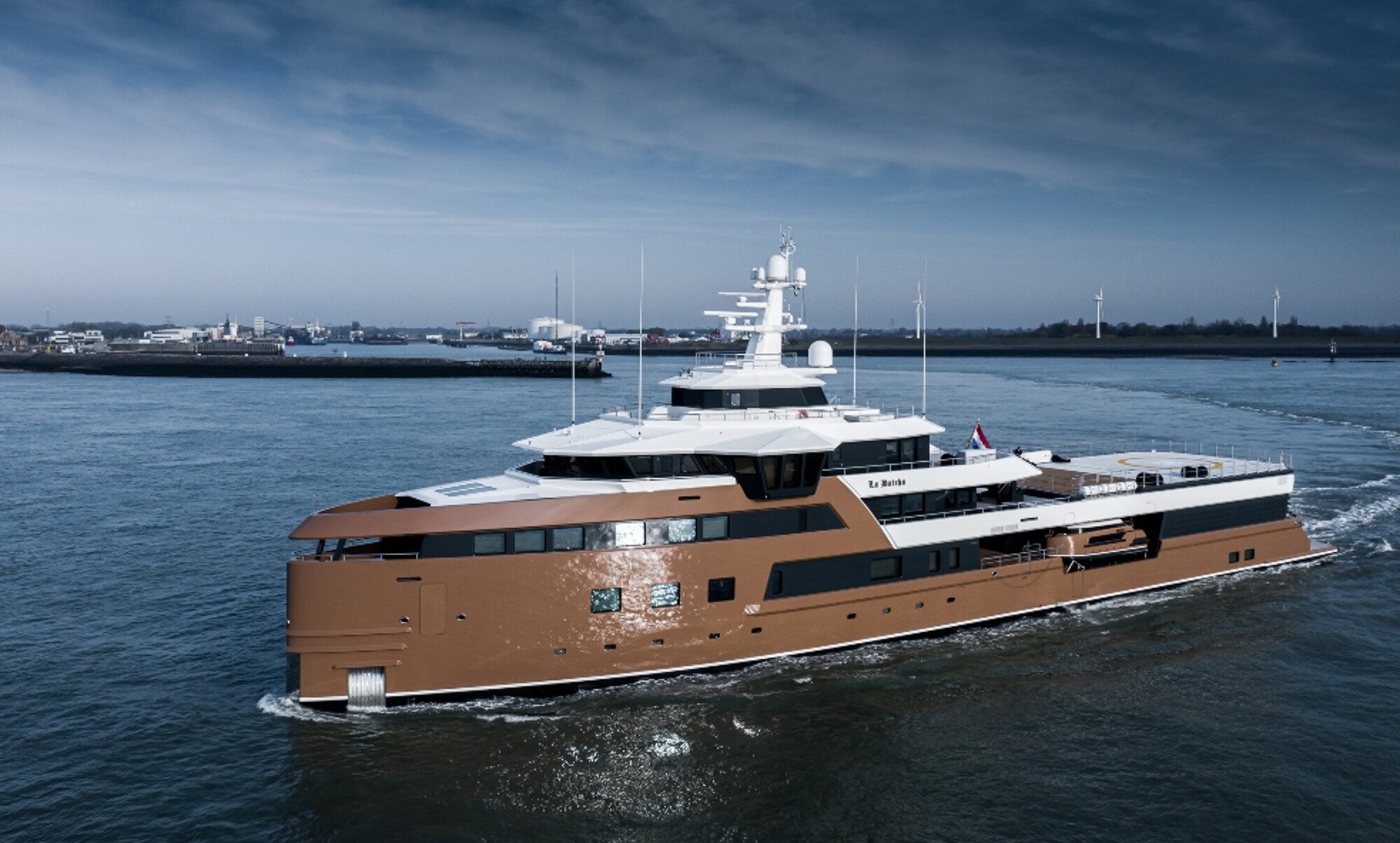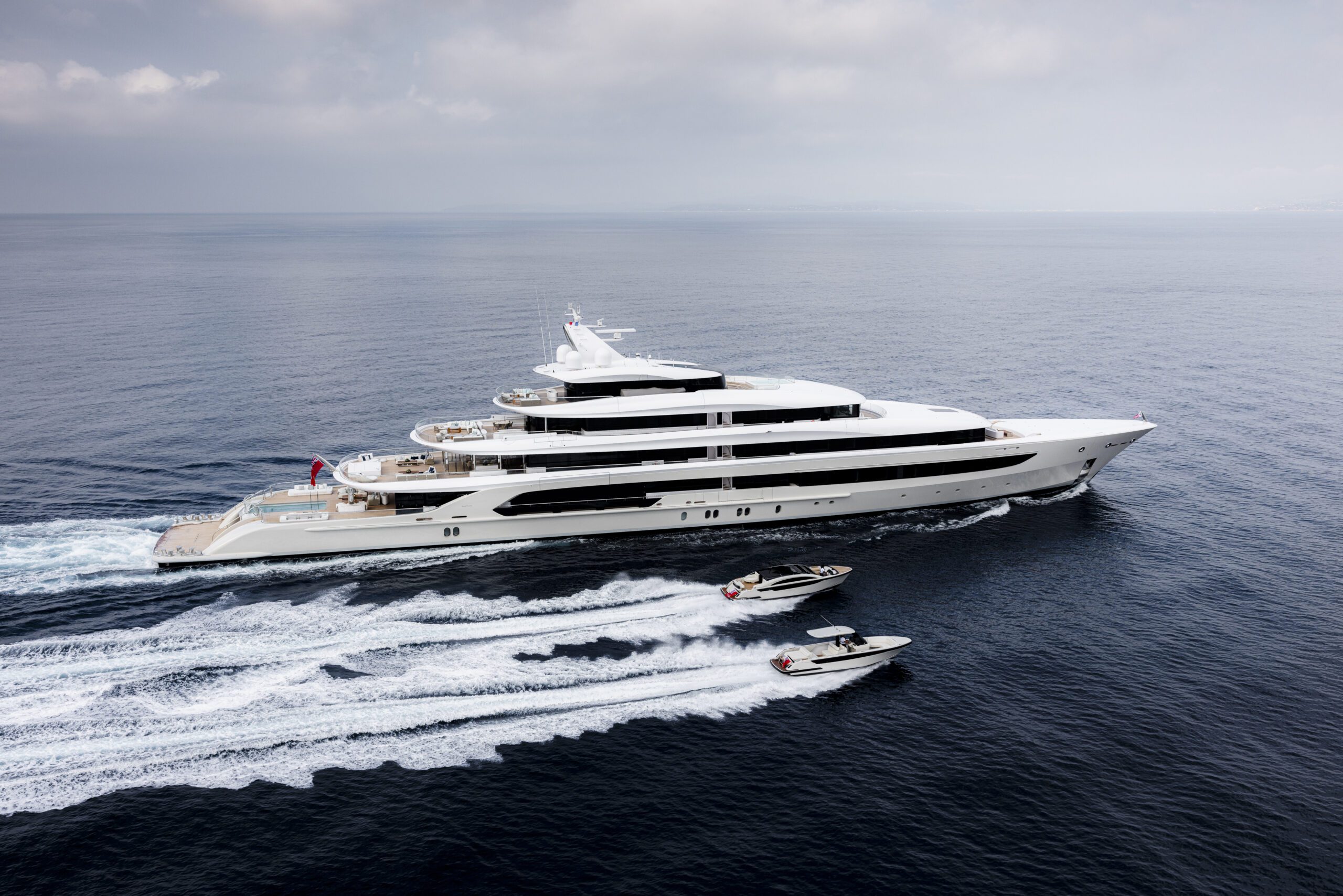

A refit refreshes a yacht. What Oceanco did to H3 replaced one. She began life in 2000 at 95 metres — Oceanco's fleet record lists her previous names as H, Neom and Indian Empress — and it was as Indian Empress that she was bought at auction in Malta. Oceanco's chairman Mohammed Al Barwani and a business associate saw the opportunity the auction room had priced as a problem: a sound, advanced hull from the turn of the century, available to be taken apart and started over. The work was supervised by The A Group as owner's representative and carried out at Oceanco's Zwijndrecht facility, the yard's base for exactly this kind of life-cycle work.
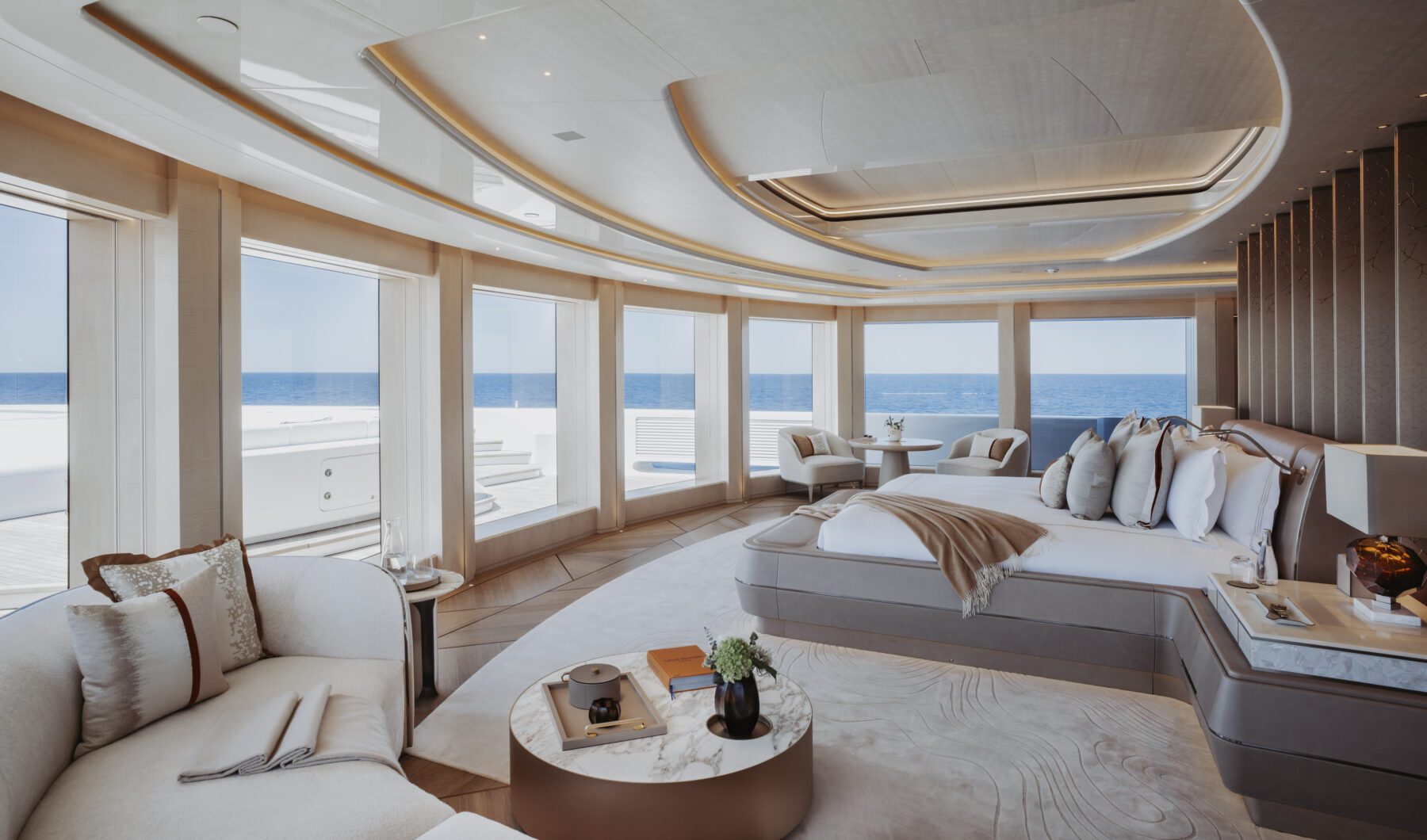
Start with the tape measure. Length overall grew from 95 to 105 metres — eight metres added aft, two forward — and the new transom was tank-tested at the MARIN basin in the Netherlands before anyone cut steel. The aft extension carries a main-deck pool with a waterfall. Gross tonnage rose from 3,045 to 3,521, and the glass count tells the design story on its own: window area went from 220 to 392 square metres, with glass bulwarks where solid railings used to be. On top sits an entirely new superstructure, with exterior and interior design both by Reymond Langton Design. BOAT International's before-and-after table records how little was left alone: 100 tonnes of aluminium and 110 tonnes of steel came out; 107 and 187 tonnes respectively went back in.
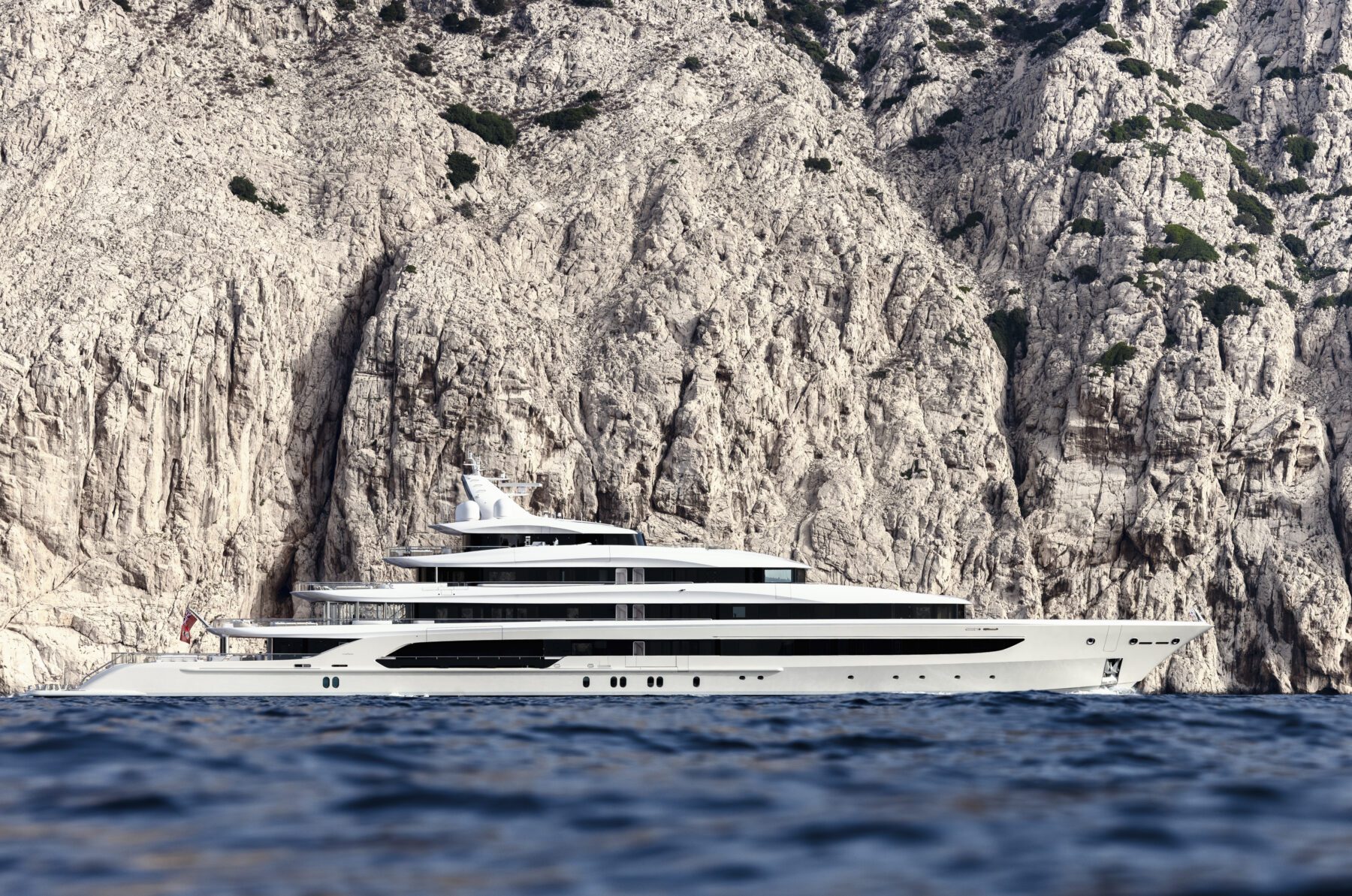
The machinery room was treated the same way. Three MTU engines of 6,720 kW each gave way to two of 2,823 kW, and the exchange was deliberate: top speed fell from 26 knots to 18 while range grew from 5,500 to 6,500 nautical miles, and the new plant brought the yacht to full IMO Tier III compliance — the current emissions standard a yacht launched in 2000 was never built to meet. The engines can also run on hydrotreated vegetable oil, a renewable fuel made from waste oils. Guest capacity, notably, went down: 20 guests in place of 32, with the volume spent on space per person instead of berths.
What survived is the point of the story. Oceanco retained around 60 per cent of the original structure, hull included, and assessed the rebuild with a full lifecycle analysis; the yard's research team credits the reuse of steel and aluminium with saving approximately 2,000 tonnes of carbon against building new. Those are Oceanco's figures, arrived at by Oceanco's method, and this piece reports them as the yard's assessment rather than as audited fact — the row's own caution, and the right one. What is independently settled is the verdict of the industry: H3 took Best Rebuilt Yacht at the 2024 World Superyacht Awards, and Lloyd's Register classifies her as a new build. Her fleet record at Oceanco reads, simply: delivered 2000/2024.
Previously's Take
Every old yacht poses the same question — restore, refresh, or start over — and the honest answer is usually dictated by what the hull is still worth. H3's answer was to treat a 24-year-old hull as raw material rather than as a relic. The name changed, the length changed, the machinery changed, the paperwork changed. The steel remembered. That is not a refit. It is a second launch, earned the hard way.
The numbers
Sources · 5 sources
- Oceanco — H3 fleet page (105 m, Reymond Langton interior, new superstructure, IMO Tier III, delivered 2000/2024, previous names)
- BOAT International — "Inside the Oceanco rebuild of 105m superyacht H3" (auction purchase, lengthening, MARIN testing, before-and-after specification table)
- BOAT International — "How Oceanco rebuilt H3" (60 per cent retained structure, lifecycle assessment, HVO capability, Lloyd's Register new-build classification)
- SWZ Maritime, 8 May 2024 — "Oceanco's H3 wins Best Rebuilt Yacht Award" (World Superyacht Awards, Tier III, Oceanco carbon-saving figures)
- Northrop & Johnson — H3 listing specifications (2000/2024, 3,521 GT, Lloyd's Register class)
Photographs: Guillaume Plisson for Oceanco · Guillaume Plisson for Oceanco · Guillaume Plisson for Oceanco