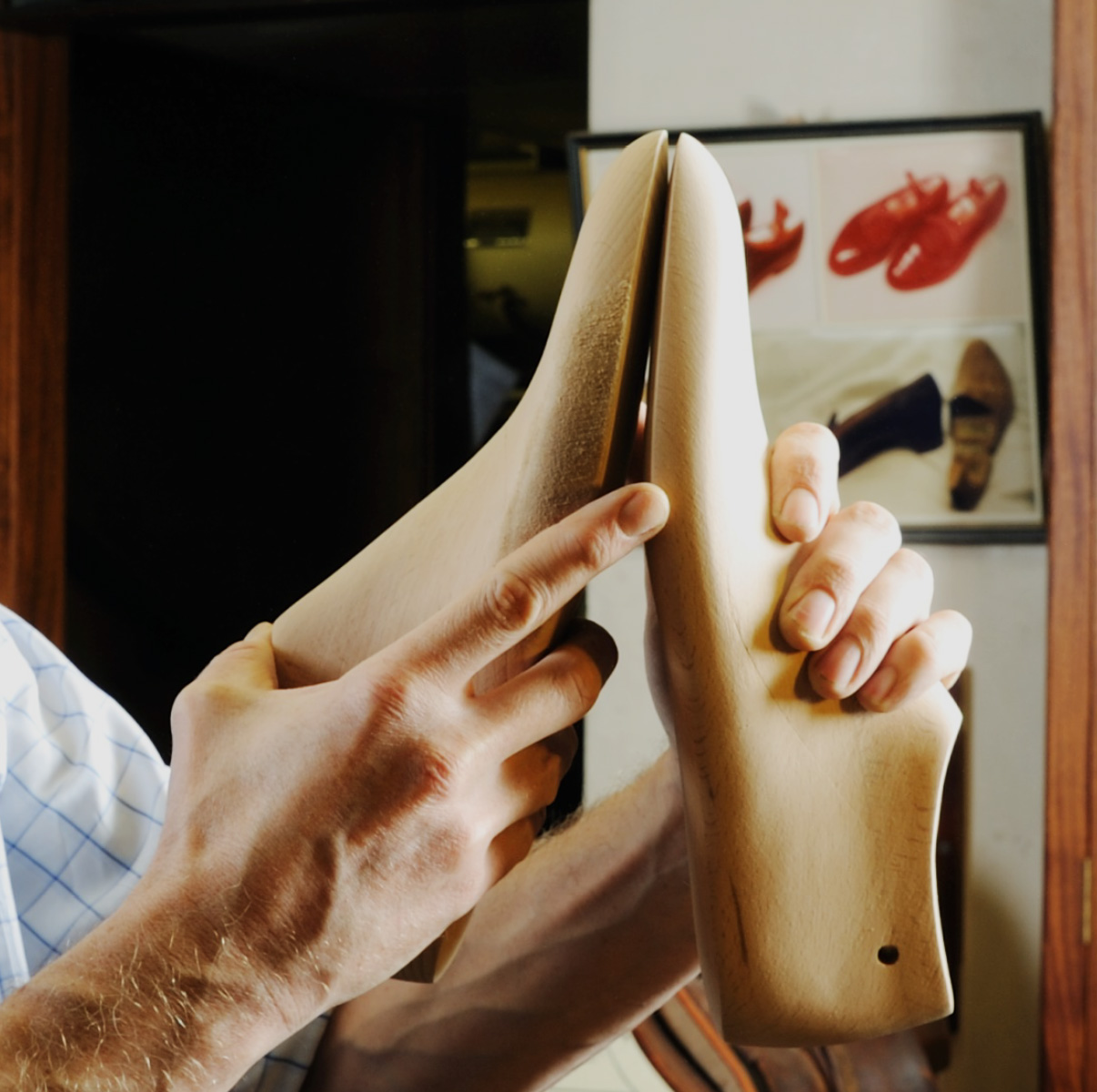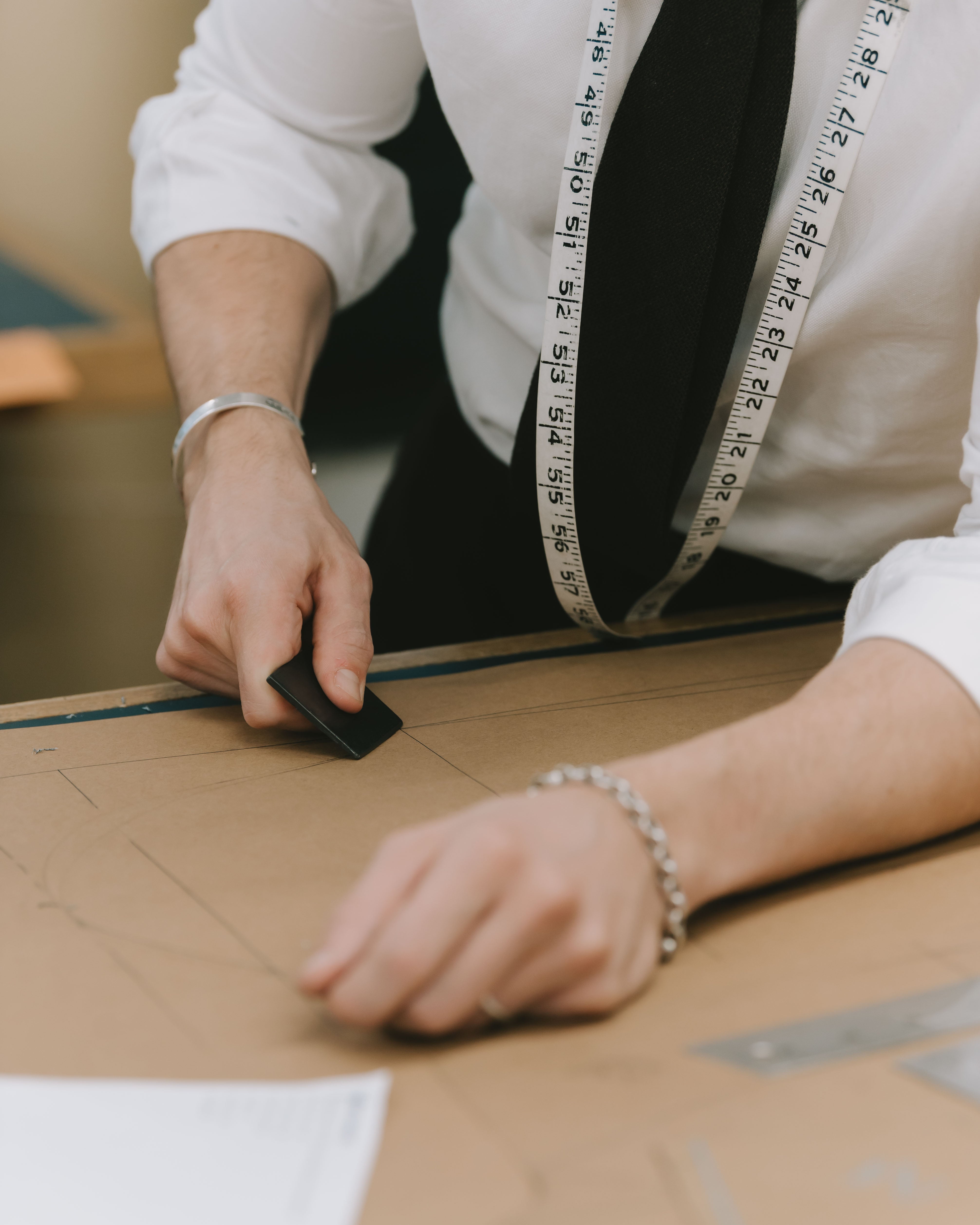

Every tailor takes measurements. The difference at Huntsman — tailoring since 1849, and working out of 11 Savile Row — is what happens next to them. Your cutter takes up to twenty-eight measurements, and then does the part no tape can do: assesses your posture and stance, asks how you prefer to stand, sit and move. A shoulder that sits forward, a hip that rides high — those go into the draft as surely as a chest size. Bespoke, done this way, is a portrait sitting where the sitter never has to hold still.
The measurements become a paper pattern, drafted entirely by hand by that same cutter. This is the dividing line in tailoring. Ready-to-wear and made-to-measure both start from a standard pattern adjusted towards you; a Huntsman pattern starts from you and nothing else. The cutter owns it end to end — the person who measured you is the person who will judge the finished garment on your back.
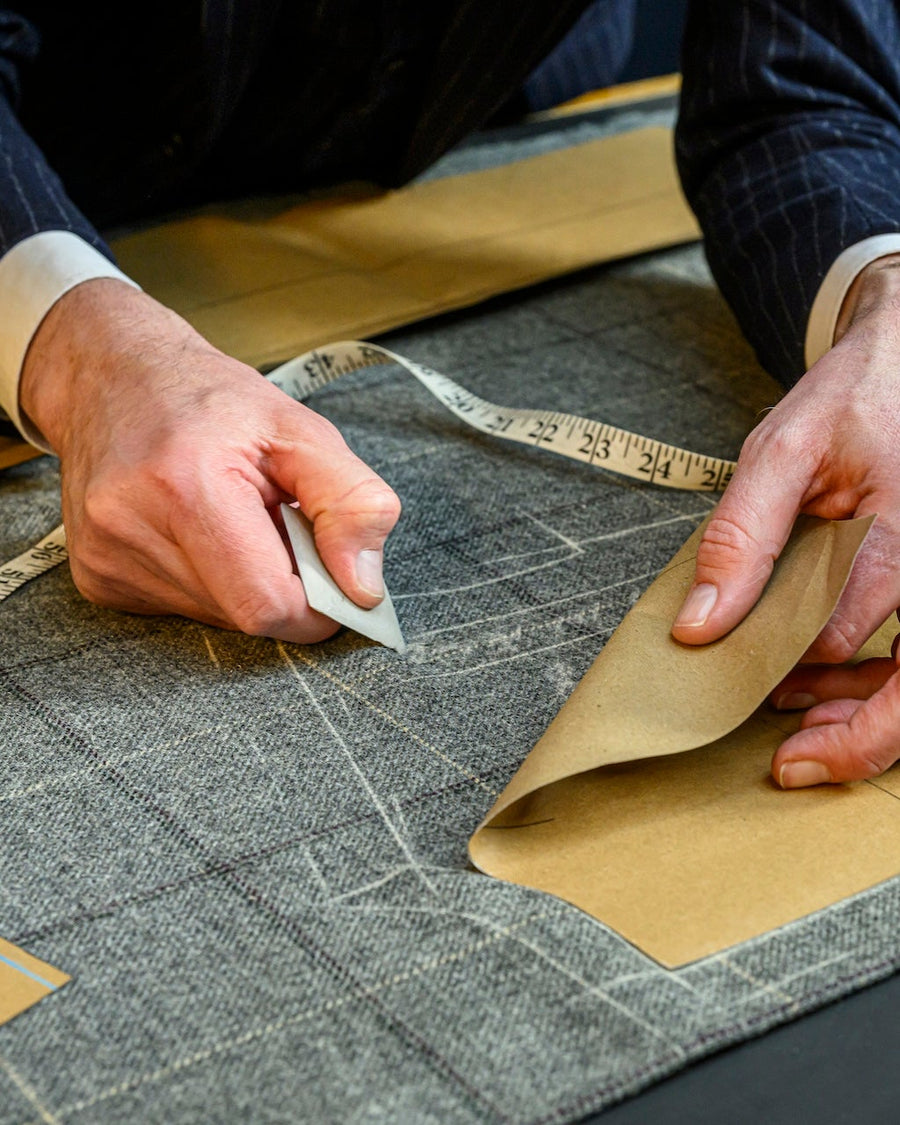
Then comes the striking. The paper pattern is laid on your chosen cloth and chalked around, section by section, with the cutter lining up checks and stripes so they run unbroken through the finished garment. The cloth is cut by hand, with shears. Huntsman's own word for the judgement involved is the cutter's "rock of eye" — the instinct for balance and proportion that sits on top of the numbers and occasionally overrules them.
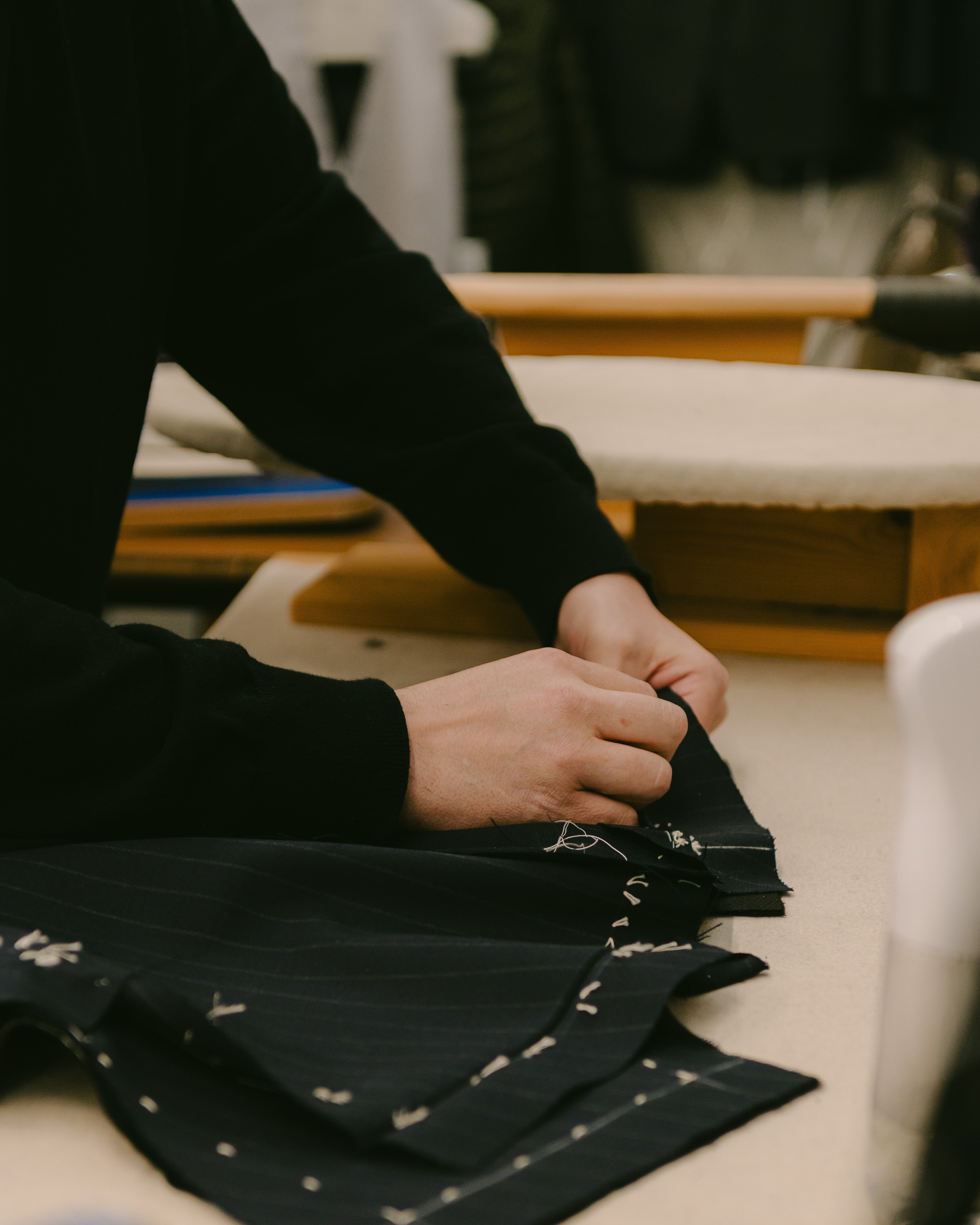
What gets sewn first is deliberately unfinished. The baste is the garment in rough form: loose white basting stitches, raw edges, chalk marks, sleeves barely attached. You wear it at the first fitting so the cutter can read the cloth on a moving body. Then the garment is taken apart — not tweaked, dismantled — and remade with every correction built in from scratch. A second fitting follows, closer to the finished thing, and Huntsman builds in a minimum of three fittings before a commission is done. Over eighty hours of handwork go into a garment, as many as six thousand hand stitches and as many as fifteen pairs of hands, all of it inside the Savile Row workrooms — Huntsman makes everything in store, and aims to deliver within fourteen to sixteen weeks of the first appointment.
The house has a signature the pattern is steered towards: the Huntsman cut, devised by head cutter Colin Hammick in the second half of the twentieth century from the hacking jacket — firm shoulders, a high armhole, a waisted silhouette with a longer flared skirt, closed with a single button. It is one of the hardest cuts to execute and the one the house stakes its name on, worn over the decades by Gregory Peck, Paul Newman and Frank Sinatra.
And the price, stated once: bespoke at Huntsman starts from £7,500. That is a starting figure — cloth and commission decide the final one — but it is published on the house's own page, which is its own kind of confidence.
When the garment leaves, the pattern stays. It is filed in Huntsman's archive, adjusted with every future commission, for as long as you keep coming back. The suit is yours; so is the paper it came from.
Previously's Take
This is what the premium actually buys, and it is not cloth or branding. It buys a cutter's judgement, applied to one body, and a pattern kept on file so the second suit starts from knowledge instead of measurements. A standard pattern is designed to fit everybody adequately. Huntsman's whole business is the refusal to do that.
The numbers
Sources · 4 sources
- Huntsman Savile Row — Bespoke Tailoring (starting price, house cut, 28 measurements, 80 hours)
- Huntsman Savile Row — The Bespoke Tailoring Process / Our Process (posture and stance, striking, baste fitting, 6,000 stitches, 15 pairs of hands, pattern archive)
- Huntsman Savile Row — FAQs (all garments made at 11 Savile Row; 14–16 week delivery aim)
- FashionUnited — "Bespoke Suiting 101 with Savile Row's Huntsman" (independent account of the same process: measurements transposed to a paper pattern, baste, rip down, remake)
Photographs: Huntsman Savile Row · Huntsman Savile Row · Huntsman Savile Row